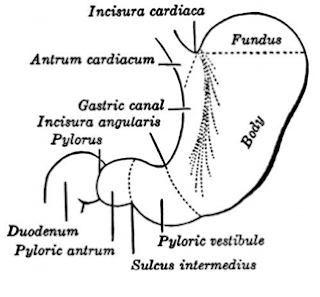
What are the parts of pylorus? The incisura angularis divides the stomach into a body to the left and a pyloric portion to the right. The sulcus intermedius further divides the pyloric portion of the stomach: the pyloric vestibule to the left, denoted by an outward convexity of the greater curvature. The pyloric antrum or pyloric canal to the right The pyloric antrum is 2.5 cm and terminates in pyloric orifice into duodenum. What happens to the normal anatomical structural in CHPS? In infants with IHPS, the pyloric ring is no longer identifiable as a clearly definable separation between the normally distensible pyloric antrum and the duodenal cap. Instead, a channel of variable length (1.5–2.0 cm) corresponding to the pyloric canal separates the normally distensible portion of the antrum from the duodenal cap. · Infantile hypertrophic pyloric stenosis was first fully described by Harald Hirschsprung i...
Febrile Seizures What is febrile seizure? Febrile seizures are seizures that are caused by a sudden spike in body temperature with fevers greater than 38C or 100.4F, with no other underlying seizure-provoking causes or diseases such as the central nervous system (CNS) infections, electrolyte abnormalities, drug withdrawal, trauma, genetic predisposition or known epilepsy. There shouldn't be any prior history of afebrile seizure as in such case the fever might be the cause of breakthrough seizure. however , there are no consensus regarding inclusion or exclusion of children with neurodevelopment disorder such as Autism spectrum disorder which has the predisposition to seizures. Age of presentation: As per American academy of Pediatrics: 6 months to 5 years (however cases unto 7 years of age have been diagnosed as FS) As per earlier definition ILAE - infant up to age of 1 month can be diagnosed as FS. As per NIH (National Institute of Health) children between 3 months and 5 years ...
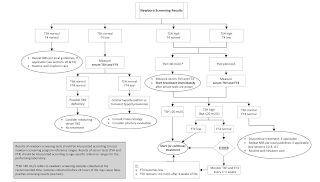
Hypothyroidism Newborn screening (NBS) for CH followed by prompt initiation of levothyroxine (L-T4) therapy can prevent severe intellectual disability, psychomotor dysfunction, and impaired growth. The influence of severity at diagnosis, timing of treatment initiation, and L-T4 dose on longterm outcomes remains a matter of debate. Although the majority of treated patients achieve normal cognitive outcomes, the influence of L-T4 therapy on neurologic development is less certain, and some studies show persistent deficits in treated patients compared with euthyroid healthy controls. If a permanent form of CH has not been established, L-T4 treatment is maintained until 3 years of age, after which thyroid function is reevaluated following a 4- to 6-week discontinuation of L-T4. Most common cause - thyroid dysgenesis, dyshormonogenesis. Less common cause - maternal antithyroid medications, TSH receptor-blocking antibodies (TRBAb) acquired through transplacental passagematernal or infan...

Comments
Post a Comment